contents How To be a scientist 4 engineering scientist's secret outdoor lab waterfall wall triangular bubble magic air cannon breathless balloon blow water wheel cotton ball cannon dirty batteries on the hunt for space rocks astronomically good telescope nature mushroom printing bug pooting what can a plant sense a feast fit for moths bee hotel color-changing flowers egg pots meteorology i can see a rainbow of sorts Touching lightning hot air cold air telling time no batteries required hold a tornado in your hands build your own weather station part 1 weather vane part 2 barometer part 3 RAIN GAUGE part 4 anemometer part 5 thermometer to your stations 8 10 12 14 16 18 20 22 24 26 30 32 34 36 38 40 42 46 48 50 52 54 56 58 59 60 62 64
How to be a scientist It’s helpful to have a notebook or journal where you can write down notes on your experiments and ideas for new ones Take your science notebook out with you and take notes on things that you see If you go on a nature walk write down or draw different birds bugs or animals you spot Keep an eye out for fossils in rocks or look for shooting stars in the sky The more you notice about the world around you the more you’ll be able to think of new questions Observe Ask questions Do bubbles have to be round Can they be triangular shaped Keep thinking of questions and writing them down If you find out the answer later add it to your notebook Try to guess what will happen before it happens This is called making a prediction What will happen if you use a longer rubber band on your cotton ball cannon What will happen if you use salt instead of sugar to make a rainbow in a jar Write down what you think will happen before you do the experiment 4
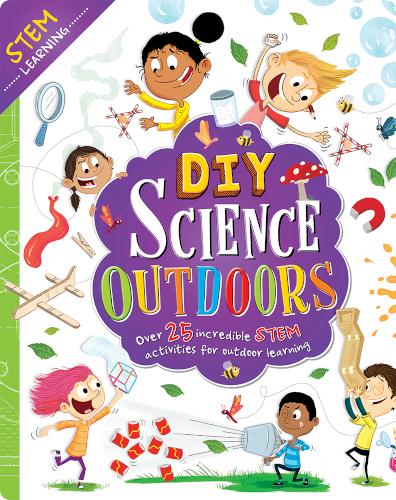
DIY Science: Outdoors
Make a bulb blaze with light using soil, become a genius at predicting the weather, and discover new planets with your own amazing telescope. Learn the science behind things that go WHOOSH, BUZZzzz, and SPLAT!
About This Book
By: Karl West
Illustrated by:
Published by: Autumn Publishing, an imprint of Igloo Books