acknowlEdGMEnts We both want to thank the No Starch Press team who have done such a great job producing this book Special thanks to Liz Chadwick for the invitation to write this book and for her endless patience editing our non-native English writing We also want to thank Laurel Chun for her attention to detail and for producing this book’s beautiful layout Thanks to Les Pounder for his technical contribution and suggestions Many thanks to the Raspberry Pi Foundation for developing this tiny but powerful computer that made electronics and coding more accessible to general public We must also thank our friends and family for being supportive throughout this entire journey Finally we would like to thank the Random Nerd Tutorials community who indirectly have also made this book possible Writing this book wouldn’t have been possible if it wasn’t for Sara Santos’s work and support and her tireless effort to meet all the deadlines I thank her greatly Rui Santos I would like to thank my coauthor Rui Santos for inviting me to take part in this journey Thanks for showing me that we can work in something we love we just have to chase our dreams Sara Santos x v i a c k n o w l E d G M E n ts
intRoduction Have you ever considered that you could buy a computer for 35 And no we’re not talking about an ancient computer from a pawn shop We’re talking about the Raspberry Pi a computer board about the size of a credit card But don’t be fooled by its fragile appearance it’s much more powerful than it seems The Raspberry Pi was developed in the United Kingdom by Eben Upton founder of the Raspberry Pi Foundation Upton and his colleagues noticed a decline in the skills of students applying to study computer science at the University of Cambridge and real ized it was because newer generations of students had grown up with computers that were easy to use The students never needed to learn how computers really work and didn’t have much oppor tunity to program or tinker Upton developed the Raspberry Pi as a way to promote teaching basic computer science in schools This is why the Pi is a bare board rather than a computer in a case so everyone can see the components of a computer More than ten million Raspberry Pi boards have been sold since it was first introduced in 2012 The Raspberry Pi has become popular not just among students but also electronics hobbyists tinkerers computer scientists and kids of all ages The Raspberry Pi can work as a regular computer you can surf the web send emails write documents watch videos and so on but that’s not its main purpose The Pi is something that you can experiment with hack and play with to build your own pro grams and inventions The Raspberry Pi and similar boards made it not only possible but easy to get involved in the world of electronics and programming resulting in an outpouring of creative inventions all over the globe Now it’s your time to invent something Who Is ThIs Book For This book is suitable for any beginners who want to make the most of the Raspberry Pi whether that’s kids who want to discover the world of electronics and programming parents and educators who want to help teach children and students or hobbyists and makers who want to use the Raspberry Pi to bring their ideas to life xvii intRoduction
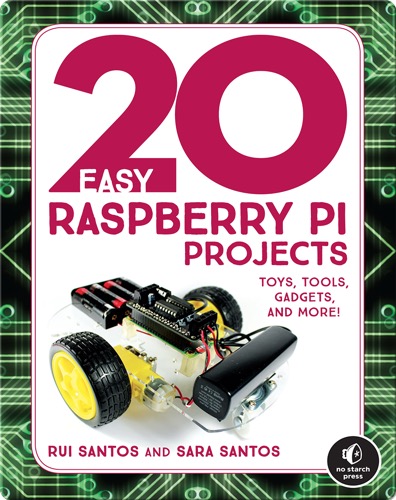
20 Easy Raspberry Pi Projects
20 Easy Raspberry Pi Projects is a step-by-step guide to the Raspberry Pi, for beginners looking to make cool things right away.