CONTENTS INTRODUCTION 12 13 18 CHAPTER 1 THE BASICs OF ASTRONOMY Astronomy Throughout Time Before the Telescope How Astronomers Study the Skies Magnifying the Heavens Telescopes The Colors of Space Spectroscopy Simulated Space Computer Models 19 20 25 27 29 30 32 36 37 38 40 CHAPTER 2 THE SOLAR SYSTEM How It All Began Just One of Many Anatomy of the Solar System Our Star The Planets and Their Dwarf Siblings Rings and Moons Our Moon How Eclipses Happen Asteroids Big Chunks Meteoroids Small Chunks Comets Icy Bits Interplanetary Medium The Tiny Stuff The Fate of the Solar System 43 47 48 49 53 57 57 60 CHAPTER 3 THE STARS How Do We Locate Them How Far Away Are They How Big and Bright Are They What Are They The Life Cycle of a Star Dense Matter Neutron Stars and Black Holes 64 66 67 70
71 Black Holes The Strangest of All Planets orbiting Other Stars Between the Stars 72 74 78 81 CHAPTER 4 THE GALAXIES Our Home Galaxy The Milky Way Energetic Galaxies Radio Galaxies and Quasars The Quasar Galaxy Connection Dark Matter The Expanding Universe 84 85 85 91 91 97 98 CHAPTER 5 THE UNIVERSE The Nature of the Universe Looking Deep The Hubble Space Telescope How the Big Bang Theory Was Developed Hubble Proves the Island Universe Theory Hubble's Law First Hints of the Big Bang The Steady State Challenge Cosmic Microwave Background Proves the Theory 99 1OO 103 106 110 117 GLOSSARY FOR MORE INFORMATION FOR FURTHER READING 120 124 INDEX 125
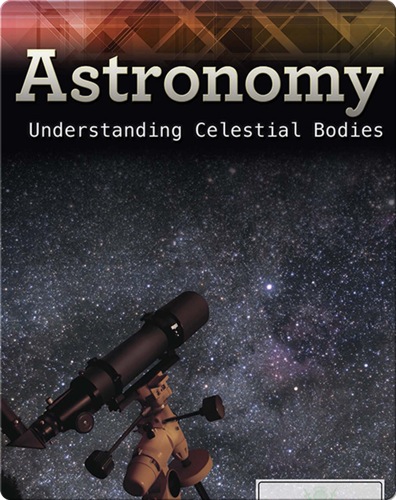
Astronomy: Understanding Celestial Bodies
From ancient times, people have recorded observations of objects in the night sky and attempted to understand the mysteries of the universe.
About This Book
By: Samuel Kazlow
Illustrated by:
Published by: Rosen Publishing provided by Britannica