CONTENTs INTRODUCTION CHAPTER 1THE FUNDAMENTALS OF LIGHT 10 CHAPTER 2 LIGHT AND MATTER CHAPTER 3 THE SPEED OF LIGHT 33 40 CHAPTER 4 PARTICLE AND WAVE THEORIES OHIO CHAPTER 5 LIGHT WAVE AND PARTICLE 56 CONCLUSION GLOSSARY FOR MORE INFORMATION FOR FURTHER READING 66 68 72 74 INDEX 75
t s hard to imagine a world without light Most of us however take for granted just how complex and intriguing this form of energy is This volume investigates the nature of light from its basic behaviors such as reflection and refraction to its rela tionship to the concepts of space and time The properties of light have puzzled sci entists for centuries Isaac Newton believed that light was composed of particles Christiaan Huygens believed it traveled in the form of a wave Even up to the early 20th century scientists could not explain why light conformed to both particle and wave theory It was not until 1924 that Louis de Broglie put forth the idea that both theories were neces sary to explain the properties of light Light is one of several forms of energy that together are known as electromagnetic EM radiation various forms EM radiation The of are arranged on a spectrum according to their wavelengths which fall within a very wide range Light is the form of EM radiation that is visible to the human eye It occupies a very narrow band within the broad EM
Light
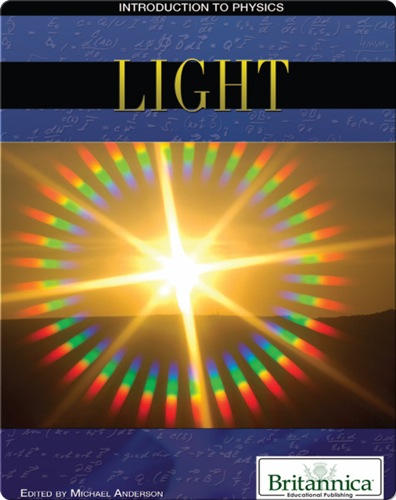
The fundamentals of light—including how it is measured and the particle and wave theories of light—are covered in this volume.
About This Book
By: Michael Anderson
Illustrated by:
Published by: Rosen Publishing provided by Britannica