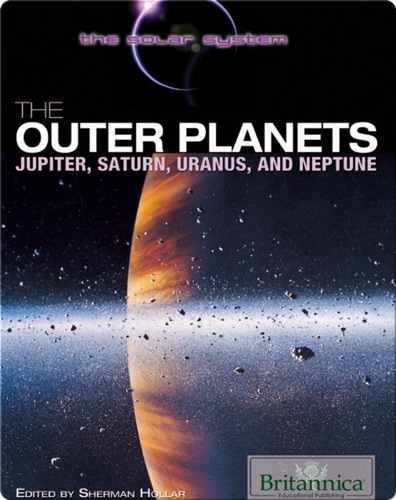
The Outer Planets: Jupiter, Saturn, Uranus, and Neptune
CONTENTS INTRODUCTION CHAPTER 1 CHARACTERISTICS OF JUPITER 10 CHAPTER 2 PHYSICAL FEATURES AND EXPLORATION OF JUPITER 22 CHAPTER 3 CHARACTERISTICS OF SATURN 37 CHAPTER 4 PHYSICAL FEATURES AND EXPLORATION OF SATURN 52 CHAPTER 5 CHARACTERISTICS OF URANIUs 62 CHAPTER 6 PHYSICAL FEATURES AND EXPLORATION OF URANIUS 71 a to CHAPTER 7 CHARACTERISTICS OF NEPTUNE 77 CHAPTER 8 PHYSICAL FEATURES AND EXPLORATION OF NEPTUNE 83 88 89 CONCLUSION GoSSARY For MORE INFORMATION BiaLIOGRAPHY INDEX 94 95
he most distant and perhaps most intriguing planets in our solar sys tem are known as the outer planets Jupiter Saturn Uranus and Neptune Of these bodies ancient astronomers could see only bright Jupiter and Saturn in the night sky Thanks to deep space probes and con stantly improving Earth based observational technology scientists today are steadily unraveling mysteries about the planets their moons and their rings This book takes you on a journey to the most remote planets in our solar system Our first destination is Jupiter the larg est planet in the solar system It is so big that more than 1 300 Earths could fit inside it It is the fifth planet from the Sun but bright enough that we can see its multicol ored stripes with only a small telescope Also visible is a red oval called the Great Red Spot which is a storm in Jupiter's atmo sphere that has been going on for more than 300 years Jupiter s surface and interior are composed mainly of hydrogen and helium The planet has 63 known moons and a nar row system of rings Its orbit is elliptical oval and one orbit is equal to about 1 86 Earth years IO
The Outer Planets: Jupiter, Saturn, Uranus, and Neptune
Spacecraft exploration of the outermost planets in our solar system reveals many features of these seemingly harsh environments.
About This Book
By: Sherman Hollar
Illustrated by:
Published by: Rosen Publishing provided by Britannica